


Classroom Projectors for Libraries and Flexible Learning Spaces
Libraries and flexible learning environments are among the most versatile spaces in a school. They are no longer used solely for quiet reading—they now support presentations, group collaboration, events, seminars, and digital learning.
Because of this multi-purpose role, the way audiovisual technology is designed—and particularly how classroom projectors for libraries are implemented—requires a different approach from standard teaching spaces.
One of the most important considerations is not just performance, but how well the technology integrates into the environment without dominating it.
How These Spaces Differ from Standard Classrooms
To understand the right approach, it helps to compare these environments directly with a typical classroom setup.
In a standard classroom, projector systems are usually:
- Front-focused, with students facing a primary teaching wall
- Fixed in position, often ceiling-mounted in predictable locations
- Used consistently throughout the day, making the display a permanent focal point
- Designed for structured delivery, with minimal variation in layout
By contrast, libraries and flexible learning spaces are:
- Often multi-directional, or without a consistently used front-of-room orientation
- Reconfigurable, with layouts that change regularly
- Used intermittently, rather than continuously
- Designed for a mix of activities, from quiet study to large group presentations
- Not centred around a single display, with AV expected to support the space without becoming a dominant visual feature
As a result, projector systems in these spaces must prioritise adaptability, subtle integration, and multi-use functionality over fixed, front-of-room performance.
When AV Needs to Disappear
In many libraries and flexible learning spaces, audiovisual systems are not in constant use. Unlike a classroom, where a display is always visible, these environments benefit from keeping technology unobtrusive.
This is where projectors offer a distinct advantage.
A well-designed school library projector system can be almost invisible when not in use. For example:
- Ceiling-mounted projectors positioned close to the ceiling or further back in the room
- Motorised projection screens that retract completely when not required
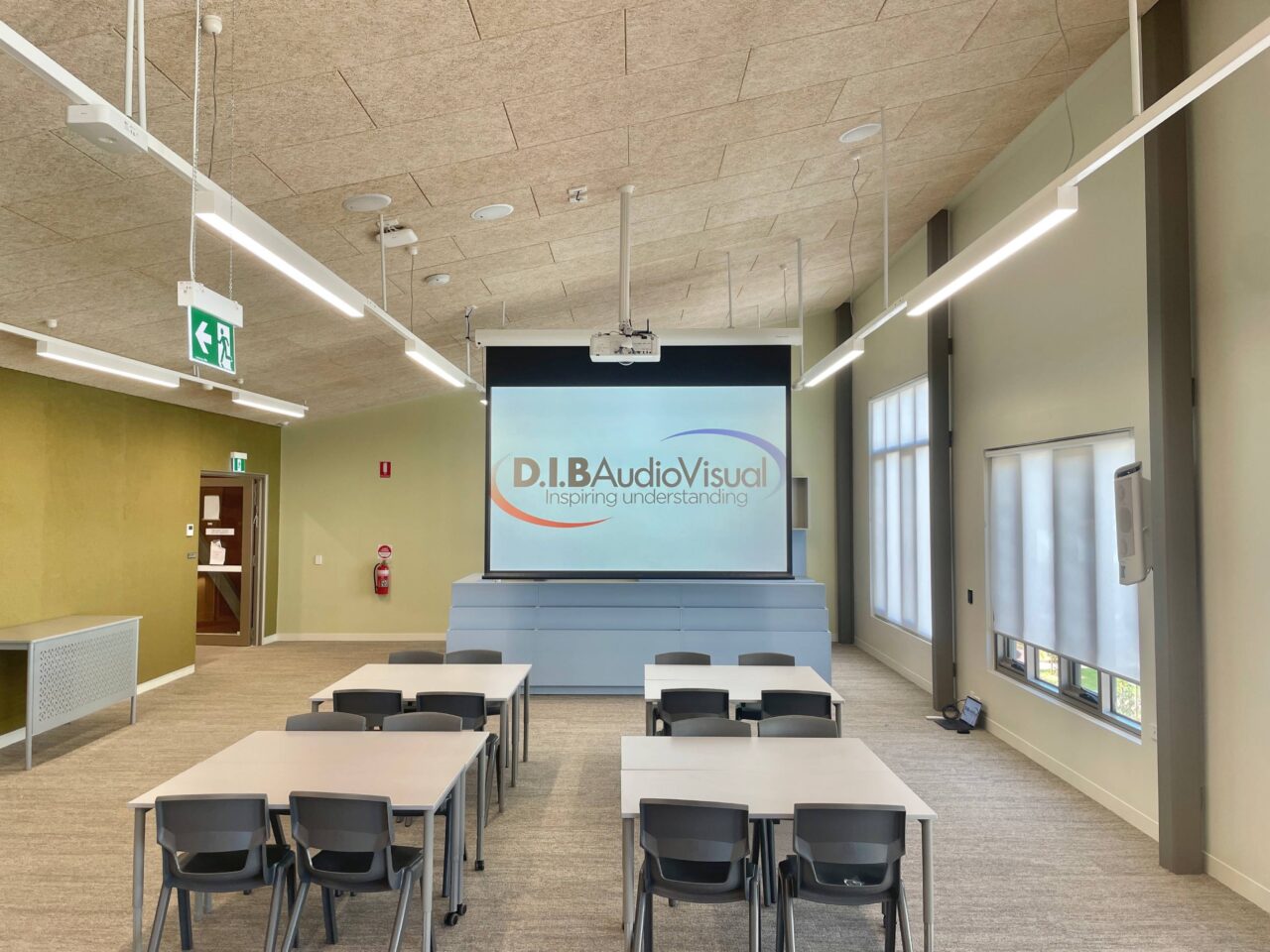
- Recessed screen boxes that conceal the screen within the ceiling, combined with carefully positioned projectors—whether ceiling-mounted, rear-of-room, or integrated into bulkheads—to minimise overall visibility
- Projection directly onto a finished wall surface, where appropriate
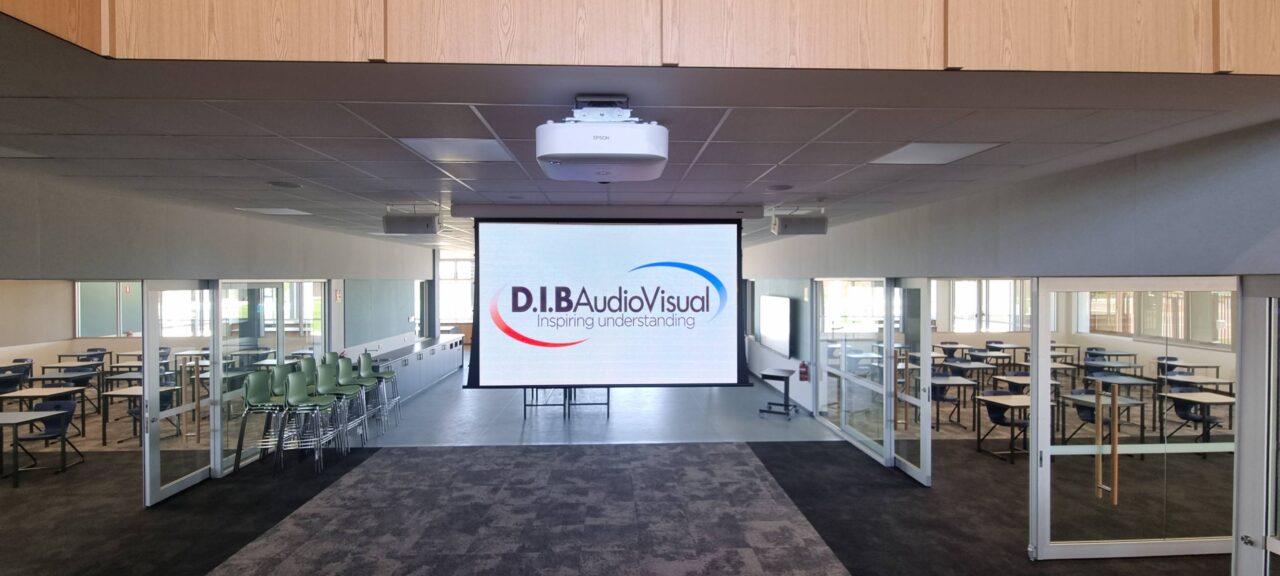
Projectors can also be mounted within bulkheads or positioned at the rear of the room, further reducing their visual presence. As ceiling-mounted elements tend to fall outside normal sightlines, these systems are less visually prominent within the space.
The result is a space where users may not be aware of any large display capability—until it is needed. At the press of a button, the projection system can be deployed, allowing the room to transition quickly into presentation mode.
This approach is not just about screens disappearing, but about the entire AV system being designed to disappear within the space.
Flexible Display Options for Multi-Use Environments
Libraries and flexible learning spaces often need to support a wide range of activities, including:
- Small group instruction
- Whole-group presentations
- Guest speakers or seminars
- Informal collaboration
Because layouts frequently change, flexible learning space projector solutions should avoid relying on fixed viewing directions.
Instead, consider:
- Wall-based projection to maximise usable space
- Strategic placement that supports multiple viewing angles
- Systems that remain effective even as furniture and layouts change

Projection onto walls is increasingly common. However, image quality is highly dependent on the surface—smooth, matte finishes in white or light neutral grey provide the most accurate and consistent results, while darker or coloured surfaces can reduce brightness and introduce colour shift.
Choosing the Right Projection Approach
In flexible spaces, placement flexibility is often more valuable than proximity to the screen.
While ultra short throw projectors are highly effective in fixed teaching environments, their reliance on precise positioning and dedicated wall space can make them less suited to highly flexible or frequently reconfigured areas.
Instead, many schools benefit from:
- Standard or short-to-mid throw projectors mounted from the ceiling
- Rear-of-room projection, provided sufficient throw distance and mounting positions are available
- Longer throw solutions for larger, open areas
These approaches support both performance and integration—allowing the technology to remain effective without becoming a dominant visual element.
Maintaining Core Performance Fundamentals
While flexibility and integration are important, the core principles of projection still apply.
Key considerations include:
- Brightness (lumens): Must suit ambient light and room size
- Image size: Should match viewing distances across the space
- Contrast and visibility: Particularly important in naturally lit environments
- Ease of operation: Systems should be intuitive for all users
Even in adaptable spaces, these fundamentals ensure the system remains practical and reliable.
Why Projectors Are Often Preferred in These Spaces
In environments where technology should not dominate the room, projection is often preferred where minimising visual impact and maintaining flexibility are key priorities.
Compared to fixed displays, projectors offer:
- Minimal visual impact when not in use
- Scalable image sizes for different group sizes
- Flexible placement, including ceiling and rear-of-room options
- Integration into architectural elements such as ceilings and bulkheads
This makes library classroom projectors particularly well suited to spaces that must remain open, adaptable, and visually uncluttered.
Connecting Back to Your Broader AV Strategy
Designing projector systems for libraries and flexible learning spaces is one part of a broader school AV strategy.
While these environments prioritise flexibility and subtle integration, other spaces—such as standard classrooms—require consistency, simplicity, and repeatable setups.
The Importance of Thoughtful Design and Installation
Designing an AV system that integrates seamlessly into a space requires precision. It involves careful coordination between:
- Room layout and sightlines
- Mounting positions and structural elements
- Screen integration and ceiling design
- Lighting conditions and projection surfaces
Small design decisions can significantly impact performance, usability, and how visible the system becomes.
For this reason, schools often benefit from working with an experienced AV integrator such as D.I.B Audio Visual. A considered design and professional installation helps ensure the system performs reliably while remaining unobtrusive within the space.
Final Thoughts
Libraries and flexible learning spaces require AV systems that support change, not restrict it.
The most effective flexible learning space projector solutions are those that:
- Integrate seamlessly into the environment
- Remain unobtrusive when not in use
- Support multiple teaching and learning styles
- Deliver consistent performance without unnecessary complexity
By focusing not just on performance, but on how the technology fits within the space, schools can create environments that remain open, flexible, and visually balanced—where the AV system is there when needed, and unobtrusive when it’s not.