


DLP vs 3LCD Projectors for Classrooms: What Schools Need to Know
Selecting the right classroom projector technology affects both teaching delivery and student engagement. When evaluating DLP vs 3LCD projectors for classrooms, schools should look beyond specifications and consider how each system performs in real, day-to-day learning environments — from bright rooms and mixed media lessons to ongoing maintenance.
Both technologies are widely used in education, but each offers distinct strengths that may better suit different classroom needs.
What Are DLP and 3LCD Projectors?
DLP (Digital Light Processing) projectors use a reflective chip with microscopic mirrors. In single-chip models, colour is produced sequentially via a colour wheel. This design can deliver strong native contrast and good black levels, and many DLP optical engines are sealed, helping reduce dust-related maintenance over time.
By comparison, 3LCD projectors use three separate LCD panels for red, green and blue light that operate simultaneously. This “continuous colour” system means full colour brightness is delivered at all times — not sequentially — supporting consistent visibility in environments with ambient light.
DLP Projector Classroom – Benefits & Considerations
Benefits
- Strong native contrast and black levels, helping text and fine details stand out
- Smooth motion handling for video and animated content
- Durable micro-mirror design, with long-term optical stability suited to extended daily use
Considerations
- Colour brightness and vibrancy may be less pronounced compared with some 3LCD models at the same lumen rating.
- Some viewers can perceive brief “rainbow effect” colour artefacts in single-chip designs.
DLP remains a solid choice where crisp contrast, compact design, and straightforward maintenance are priorities.
3LCD Projector Classroom – Benefits & Considerations
Benefits
- High colour brightness and accurate colour reproduction, thanks to three dedicated LCD panels, making images easier for students to interpret — even in well-lit classrooms.
- Wide colour gamut that supports rich visuals, diagrams, videos, and colour-coded materials without loss of detail.
- No rainbow effect, as all colours are projected simultaneously, reducing visual distraction during long lessons.
- Balanced performance across text, graphics, and multimedia — helpful for diverse teaching styles.
- Technology that powers a large portion of education and business projectors globally, reflecting widespread confidence in classroom performance.
Considerations
- In some cases, contrast performance (especially black levels) may not be as strong as some DLP units, particularly in dim environments.
For many schools, 3LCD’s colour clarity and balanced brightness help maintain engagement across varied lesson types and lighting conditions.

Why Colour Light Output Matters in Schools
In dark environments, native contrast ratios can dominate projector comparisons. However, most classrooms operate with moderate to high ambient light. Lights remain on for note-taking, daylight enters through windows, and students sit at varying distances.
In these conditions, perceived clarity depends heavily on colour light output, not just white brightness.
The human retina contains red, green and blue-sensitive cones. For colours to appear bright and saturated, these cones must be stimulated simultaneously.
3LCD projectors display red, green and blue light continuously at the same time. Because colour brightness matches white brightness, the result is:
- More vivid diagrams and maps
- Clearer differentiation of colour-coded learning materials
- Stronger dynamic range at typical classroom viewing distances
- Improved readability without dimming the room
Single-chip DLP projectors generate colour sequentially using a colour wheel. The eye blends these rapid flashes through image persistence. While this creates a full-colour image, perceived colour brightness and saturation can be lower in higher ambient light environments.
When compared side-by-side in a lit classroom, differences in colour vibrancy can become noticeable — particularly with graphic-rich teaching content.
Viewing Distance & Perceived Sharpness
Up close, DLP projectors can appear extremely sharp due to narrow pixel spacing in reflective micro-mirror designs.
However, at typical classroom viewing distances, perceived clarity depends more on dynamic range — the difference between the brightest and darkest visible elements in real lighting conditions.
Because 3LCD systems deliver continuous primary colour output, they can maintain stronger perceived brightness and colour separation across the image. In brighter classrooms, this often translates to clearer visuals for students seated further back.
Long-Term Performance Considerations
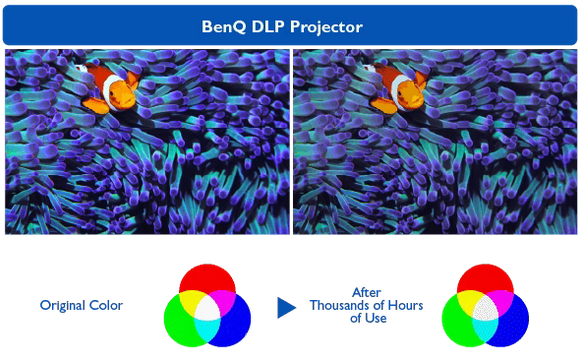
DLP technology is widely recognised for optical durability and stable performance over thousands of operating hours. Sealed light paths can reduce dust contamination, appealing to IT managers planning long-term maintenance cycles.
3LCD systems, meanwhile, maintain consistent colour brightness throughout their operational life, which can be particularly valuable in schools where projectors are used daily in well-lit environments.
When evaluating DLP vs 3LCD classroom projector comparison, schools should consider how lighting conditions, lesson style and seating layout influence real-world image perception — not just specification figures.
DLP vs 3LCD Classroom Projector Comparison
| Feature | DLP | 3LCD |
| Native Contrast / Black Levels | Typically stronger | Good |
| Colour Brightness | Good | Typically stronger at same lumen rating |
| Visibility in Bright Rooms | Good | Often better due to continuous colour output |
| Motion Handling | Smooth | Very good |
| Rainbow Effect | Possible in single-chip | None |
Both technologies deliver reliable classroom performance, but environments with a lot of visual content and ambient light often benefit from 3LCD’s colour performance.
Which Projector Technology Is Better for Schools?
There’s no one-size-fits-all answer — the best choice depends on classroom size, content type, and long-term support considerations. In general:
- DLP projectors excel with contrast and crisp visuals, which can be ideal for text-heavy lessons or dimmed classrooms.
- 3LCD projectors generally provide more vibrant colour and brightness, which is especially useful in well-lit classrooms and for content that includes diagrams, graphics, and videos.
Evaluating DLP vs 3LCD projectors for classrooms alongside related factors — such as laser vs lamp light sources, lumen requirements, and projector resolution — ensures a solution that supports clear, engaging instruction every day.
Both technologies are proven and reliable. However, when prioritising readability, colour clarity, and everyday classroom visibility, 3LCD projector classroom systems often align well with typical education needs, while DLP projectors remain a solid choice for contrast-focused classes.
The best outcome comes from matching technology with room size, lighting, and lesson style. Schools should also consider related factors such as laser vs lamp light sources, lumen requirements, and resolution to complete their DLP vs 3LCD classroom projector comparison.