


Laser vs Lamp Projectors in Schools: Which Lasts Longer and Costs Less?
For modern schools with multiple teaching spaces and high daily use, laser projectors are the clear winner in terms of overall value. While lamp projectors remain a viable choice for low-use rooms or tight budgets, laser systems generally deliver longer lifespan, lower maintenance, consistent brightness, and predictable total cost of ownership — making them the most practical option for schools that need reliable performance and minimal disruption.
Choosing the right classroom projector is no longer just about brightness or screen size. For schools managing tight budgets, limited IT resources and dozens of teaching spaces, the projector light source has a significant impact on lifespan, maintenance workload and long-term cost.
When comparing laser vs lamp projectors for schools, the key questions are practical:
- Which lasts longer?
- Which costs less over time?
- Which creates fewer disruptions for teachers and IT staff?
This classroom projector light source comparison outlines the differences between lamp and laser technology and provides a framework to help Principals, Business Managers and IT teams make confident, whole-of-life decisions.
Lamp vs Laser Technology: How They Work
At a basic level, both lamp and laser projectors can deliver bright, high-quality images for classrooms. They differ primarily in how they generate light:
- Lamp projectors use high-pressure mercury lamps that gradually degrade and require replacement.
- Laser projectors Use solid-state laser diodes and phosphor systems with no traditional bulb to replace. Brightness degrades more slowly and predictably.
While performance may look similar on day one, the ownership experience over several years can be very different. These distinctions have practical consequences for lifespan, maintenance, brightness stability and cost.
How Long Do They Last?
Lamp Projectors
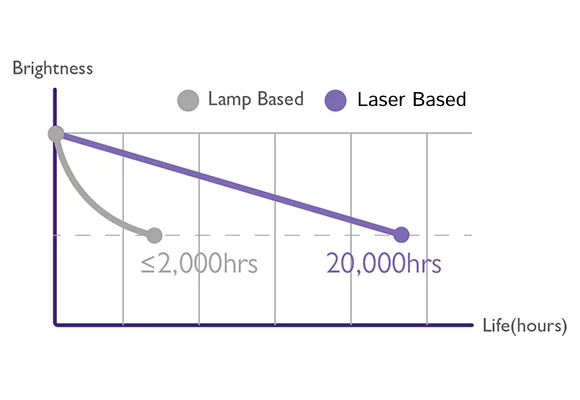
- Typical lamp life: ~3,000–5,000 hours in standard mode. With eco modes, some claim up to ~6,000–10,000 hours.
- Brightness diminishes steadily over time.
- Frequent classroom use often means 1–2 lamp changes per unit over several years.
Importantly, lamp life ratings generally refer to the point where brightness has dropped to around 50% of the original output, not when the lamp completely fails. As a result, many schools replace lamps earlier due to visible dimming rather than reaching the published hour rating.
In real classrooms, eco mode isn’t always used as brightness and colour vibrancy are important aspects in learning and student engagement.
Laser Projectors
- Rated light source life: 20,000–30,000+ hours.
- Brightness remains stable throughout most of the advertised lifespan.
- No lamp replacements.
In a classroom used 6–7 hours per day, a lamp projector might need lamp replacements as often as every 12–24 months, whereas at similar daily usage, a laser projector can often operate for 7–10+ years without light-source service.
What this means for schools
Lamp projectors typically require multiple interventions during their life. Laser projectors often run through an entire asset cycle with minimal servicing.
For schools managing dozens of rooms, this difference quickly adds up in labour and downtime.
Maintenance and Downtime
Maintenance affects more than budgets — it affects teaching time and workload for technical staff.
Lamp projectors require:
- Regular lamp replacements
- Access equipment and labour
- Spare lamp inventory
- Unexpected failures mid-lesson
- More heat and fan usage
Laser projectors offer:
- No consumable lamps
- Fewer service visits
- Reduced downtime
- Lower ongoing support requirements
Lamp projectors also require warm-up before full brightness and cool-down after use to avoid damage, which can interrupt lessons if teachers try to power them on or off frequently. Laser systems, by contrast, provide near-instant start-up and shutdown, reducing class interruptions and minimizing delays.
For IT teams responsible for many classrooms, reducing repetitive maintenance tasks can significantly free up time and reduce disruptions.
Cost Comparison: Whole-of-Life
Upfront Costs
- Lamp projectors: lower initial purchase price
- Laser projectors: higher upfront investment
Ongoing Costs
Lamp projectors incur:
- Replacement lamps (parts cost)
- Labour for installation
- Downtime and maintenance scheduling
- Gradual brightness loss that shortens useful life
Laser projectors typically avoid:
- Consumable lamps
- Frequent servicing
- Most recurring maintenance
Industry analyses show that while lasers cost more initially, the total cost of ownership — including consumables and support — can be comparable or even lower over several years.
Projector lamps tend to dim gradually and unevenly, while laser systems typically deliver stable brightness and colour for longer. For classrooms with bright ambient light or frequent use, laser projectors help ensure consistent image quality.
Over a typical 5–7 year school lifecycle, the total cost of ownership (TCO) often becomes comparable — and in high-use rooms, laser can be less expensive overall.
Performance in Real Classrooms
Beyond cost, day-to-day usability has a noticeable impact on teaching.
Laser projectors often provide:
- Near-instant start-up
- Quick shutdown
- Stable brightness throughout the day
- Better suitability for frequent on/off use
- Consistent colour over time
- Lower heat output and quieter operation
Lamp projectors may:
- Require a warm-up period before reaching full brightness
- Need a cool-down cycle before powering off safely
- Dim gradually as the lamp ages
- Generate more heat, which can affect internal components and cooling needs
Additional advantage of lasers: They support wider color gamuts due to the purity of the light source, delivering more vibrant and accurate colours for lessons, presentations, and videos. Lamp projectors are more limited in color reproduction, particularly as the lamp ages.
In practice, these factors mean teachers experience fewer delays, more consistent image quality, and less IT intervention when using laser systems.
For heavily used teaching spaces, faster start-up, shutdown and consistent performance often make laser systems feel more responsive and reliable.
A Practical Way to Decide
To choose between laser vs lamp projectors for schools, it helps to take a structured planning approach that considers usage, costs, and operational impact.
1) Estimate Annual Usage
Calculate how many hours a projector is likely to run each year:
- Daily use (6–8 hrs) × ~180–220 school days = ~1,000–1,760 hrs/yr
Higher annual hours increase the number of lamp replacements needed and accelerate brightness loss.
Pro tip: Use your school’s schedule and typical deployment patterns to make this estimate as accurate as possible.
2) Build a Total Cost of Ownership (TCO) Model
Don’t just compare purchase prices. Include:
- Replacement lamps and anticipated frequency
- Labour time for maintenance
- Downtime impacts when units are out of service
- Disposal costs for used lamps
This approach often reveals that laser projectors can match or beat lamp solutions on total lifecycle cost — especially in high-use environments.
3) Consider Maintenance Overhead
Ask:
- Do we have in-house AV/IT support that can handle regular lamp replacements?
- Is scheduling and access (e.g., ladders or lifts) a challenge?
- How critical is uninterrupted classroom uptime?
Laser projectors significantly reduce the frequency of these maintenance tasks, freeing up technical staff time for other priorities.
4) Match Brightness Needs to Classroom Conditions
Laser systems generally maintain higher perceived brightness longer than lamps, which can be advantageous in spaces with significant ambient light or larger screens.
5) Align with Replacement and Asset Cycles
Typical school technology refresh cycles fall in the 5-9 year range. Laser projectors with 20,000+ hour lifespans often align well with these cycles — potentially lasting through an entire asset plan without major light source service events.
Quick Decision Checklist
| Classroom Use Pattern | Best Fit | Why |
| Low annual use | Lamp | Lower initial cost, fewer lamp cycles |
| High annual use | Laser | Lower lifetime maintenance, better uptime |
| Limited IT/AV support | Laser | Fewer consumables and service needs |
| Tight capital budget | Lamp | Lower upfront spend |
| Long lifecycle planning | Laser | Light source outlasts refresh cycle |
Final Thoughts
Both lamp and laser projectors remain viable options. However, for many modern schools with high daily usage and limited IT capacity, laser projectors offer:
- Longer lifespans
- Fewer service events
- Predictable brightness and color performance
- Quieter operation
- Instant-on usability
Lamp projectors are still appropriate for low-use rooms or tighter budgets but require planning for lamp replacement, maintenance time, and classroom disruptions.
The best choice depends on usage patterns, support capacity, and lifecycle planning — not just price.
A thoughtful, evidence-based approach will almost always deliver better outcomes than simply choosing the cheapest option.
If you’re undecided which option is best for your school, D.I.B Audio Visual can guide you through the choice — email info@dibaustralia.com.au or call 03 9457 4800.