

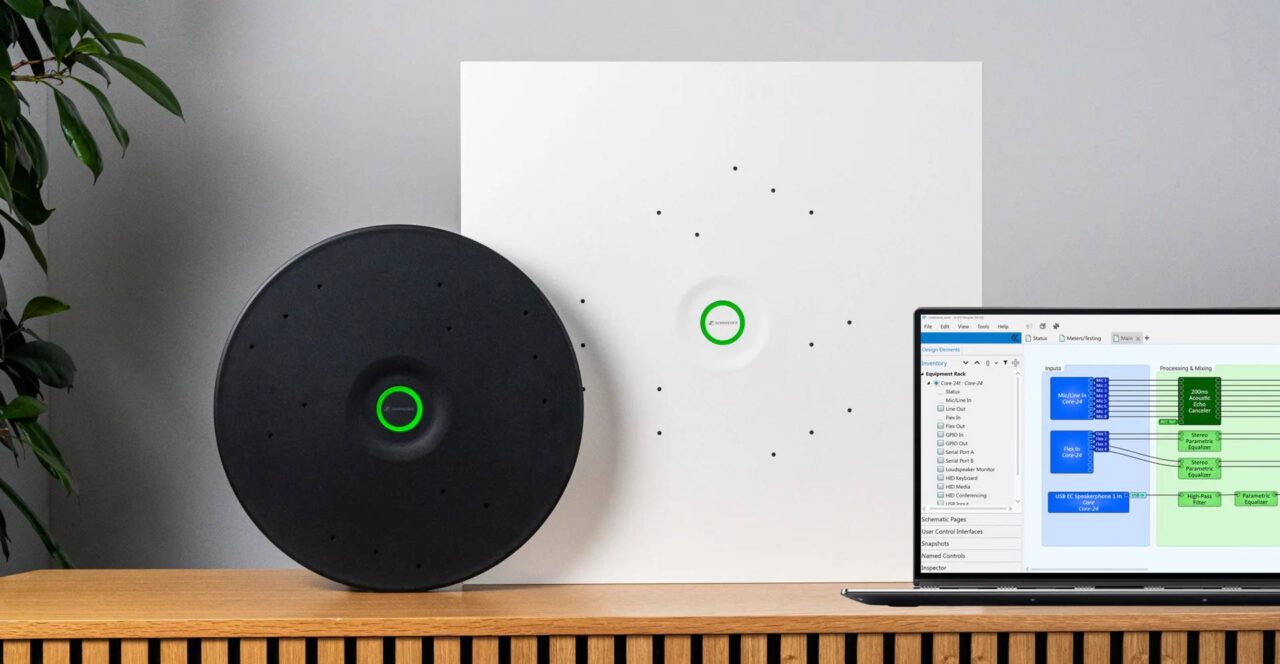
Sennheiser TeamConnect Ceiling M Plus: Smarter Audio for Flexible Spaces
As classrooms, meeting rooms and collaboration spaces become more adaptable, audio systems need to accommodate more than a fixed microphone position. Teachers move around classrooms, meeting participants contribute from different locations, and hybrid sessions bring people together both in the room and online.
The Sennheiser TeamConnect Ceiling M Plus is designed for these types of environments. The latest addition to Sennheiser’s TeamConnect Ceiling range combines ceiling-mounted microphone technology with automatic dynamic beamforming, flexible connectivity, AV platform integration and centralised device management.
For schools, businesses and organisations planning new AV systems, it provides an alternative to conventional tabletop or handheld microphones in spaces where people need freedom to move and interact.
Why Ceiling Microphones for Flexible Spaces?
Traditional microphones can work well when speakers remain in predictable positions. A tabletop microphone, for example, can be effective in a boardroom where participants sit around a table throughout a meeting.
However, many contemporary spaces have less defined layouts.
A classroom might involve a teacher moving between different areas while students participate in group activities. A professional learning room may be rearranged for presentations, workshops or discussions. A meeting room may need to accommodate both in-person and remote participants.
A ceiling microphone moves the capture point away from the furniture and into the room itself. Instead of requiring each speaker to remain close to a microphone, the system is designed to capture voices from across the space.
The TCC M Plus is designed for voice pickup up to 4.3 metres, with coverage suited to spaces of up to 60 square metres under Sennheiser’s stated conditions. It uses 15 precision-engineered microphone capsules to capture audio across the room.
This approach can reduce equipment on tables and help keep the microphone system unobtrusive, while providing greater freedom when designing or rearranging a space.
Automatic Beamforming and Speech Capture
One of the TCC M Plus’s key technologies is automatic dynamic beamforming.
Beamforming uses multiple microphone capsules to identify where sound is coming from and focus audio capture towards the active speaker. Dynamic beamforming allows that pickup direction to change as different people contribute to a conversation.
This can be useful in environments where speakers do not remain in one location.
For example, a teacher may move from the front of a classroom to work with students at different tables. In a meeting, participants may contribute from different sides of the room. Rather than relying on a fixed microphone position, the ceiling-mounted system can adapt to the location of the speaker.
Sennheiser also includes enhanced exclusion zones, which are designed to help manage unwanted audio pickup and support camera-tracking applications in more complex rooms.
The TCC M Plus is designed to support speech intelligibility while also providing features such as TruVoiceLift for in-room voice reinforcement. Sennheiser specifies a frequency response of 100 Hz to 16 kHz and a signal-to-noise ratio of 79 dB(A).
These capabilities can be relevant to both in-person and hybrid environments. Remote participants need to hear people in the room clearly, while those physically present may also benefit from voice reinforcement in larger spaces.
However, microphone technology is only one part of the result. Room acoustics, background noise, ceiling height, speaker positioning and loudspeaker selection should all be considered when designing a system.
Integration with Modern AV Systems
A professional microphone rarely operates independently. In a meeting or teaching space, audio may need to work alongside loudspeakers, cameras, digital signal processors, control systems and conferencing platforms.
The TCC M Plus provides several connectivity options, including single-cable, split-mode and daisy-chain configurations. It also supports Dante, allowing it to form part of a compatible networked audio system.
Another feature is PartnerLink, which allows supported third-party AV platforms to configure the microphone within their own workflows.
Sennheiser initially announced Q-SYS integration through PartnerLink, allowing the TCC M Plus to be configured within Q-SYS Designer. The company has also indicated that PartnerLink is intended to support additional platforms over time.
For AV and IT teams, this type of integration can help bring compatible devices into a more unified system environment.
The exact approach will depend on the organisation’s existing infrastructure and the requirements of the room. Compatibility between the microphone, DSP, conferencing platform, cameras, control system and network should be established during the design process.
Centralised Device Management
For a single meeting room, managing AV equipment can be relatively straightforward. The challenge becomes greater when an organisation has multiple classrooms, meeting rooms or buildings.
The TCC M Plus integrates with Sennheiser DeviceHub, the company’s cloud-based platform for device management. According to Sennheiser, DeviceHub provides centralised visibility, remote monitoring, configuration and diagnostics, as well as role-based access.
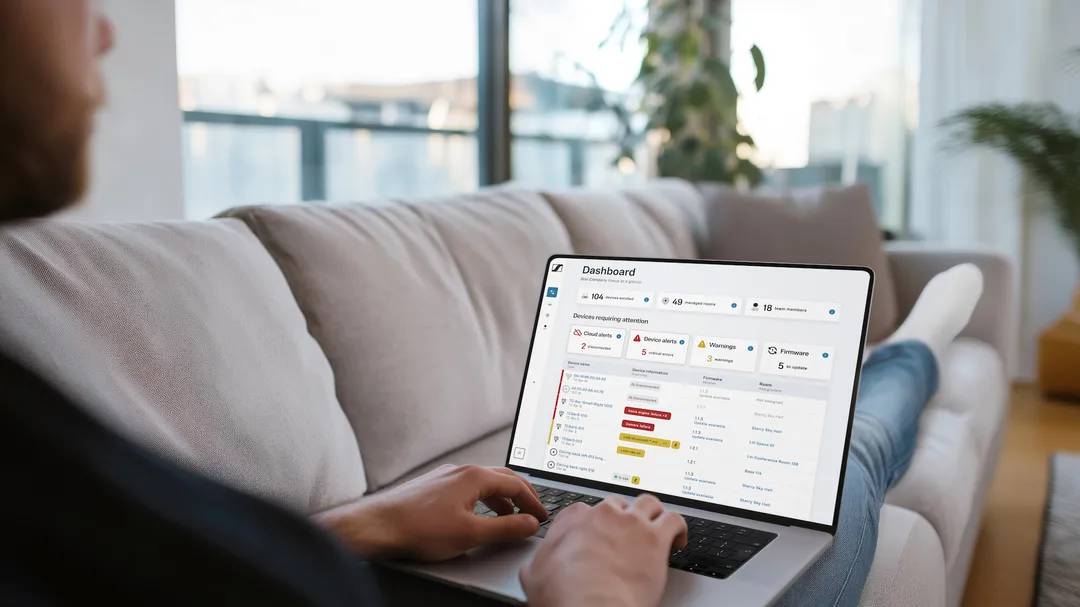
This can be particularly useful for schools and organisations with distributed AV infrastructure.
An IT or AV team may need to monitor equipment across multiple rooms without physically visiting every location. Centralised management can provide a way to maintain visibility of compatible devices and support troubleshooting and configuration from a central environment.
For larger deployments, this approach can also help make AV management more consistent as additional compatible devices are introduced.
Installation and Room Design
The TCC M Plus measures approximately 591 mm square and 46 mm high, with a weight of approximately 4.1 kg. It can be installed using the supplied flush-mount or suspension hardware, giving installers options depending on the ceiling and room requirements.
Its ceiling-mounted format is designed to keep the microphone above the activity taking place below.
However, installation should not be considered separately from the rest of the room. Ceiling construction, services, lighting, ceiling height and access requirements all need to be considered before installation.
Acoustics are equally important. Hard surfaces, reverberation and background noise can affect microphone performance, regardless of the technology being used. Loudspeaker placement should also be considered carefully so that the system provides appropriate coverage without creating unnecessary sound entering the microphone.
For this reason, a ceiling microphone should be specified as part of a complete room design rather than simply added to an existing space without assessing its acoustic and technical conditions.
Where Can the TeamConnect Ceiling M Plus Be Used?
The TCC M Plus is designed for medium and large spaces where people may speak from different positions.
Meeting and boardrooms
In conferencing environments, ceiling pickup can provide an alternative to multiple tabletop microphones, particularly where participants need to move around the room.
Training and professional learning rooms
Flexible training spaces can benefit from microphone coverage that is not tied to one particular furniture arrangement.
Collaboration spaces
Rooms used for workshops, presentations and group discussions can use ceiling microphone technology to support conversations occurring across the space.
Multipurpose and divisible rooms
Where spaces are used for different activities, microphone placement needs to work with changing room layouts. A ceiling-based approach can provide greater design flexibility, although larger or divisible spaces may require multiple microphones and additional system design.
The appropriate configuration will depend on the room size, acoustics, expected usage and wider AV requirements.
The Right Microphone Depends on the Room
Choosing a ceiling microphone is not simply a matter of selecting a model with the right specifications. Room dimensions, acoustics, ceiling construction, expected speaker locations, conferencing requirements and existing AV infrastructure all influence whether this approach is suitable.
For schools and businesses, these factors also need to be considered alongside how the space is actually used.
A classroom designed for teacher-led instruction may have different requirements from a flexible learning area used for group activities. Similarly, a boardroom may prioritise conferencing and camera integration, while a training room may need to accommodate presentations, workshops and different furniture arrangements.
An AV assessment can help determine whether the TCC M Plus is appropriate for the space, how it should integrate with the wider system, and what additional components may be required.
This approach also helps organisations avoid treating the microphone as an isolated product decision. The most effective solution is one where microphone coverage, acoustics, loudspeakers, DSP, cameras, control and network infrastructure are considered together.
A Considered Approach to Modern AV Audio
The Sennheiser TeamConnect Ceiling M Plus brings together automatic dynamic beamforming, ceiling-based voice capture, flexible connectivity, Dante support, PartnerLink integration and centralised management through DeviceHub.
For schools and businesses, its value lies in how these features can be incorporated into a carefully designed room. Where people need to move, collaborate and communicate from different positions, ceiling microphone technology can provide an alternative to more traditional microphone arrangements.
The important question is not simply whether the TCC M Plus has the right features, but whether those features are appropriate for the room, its users and the wider AV system.
Planning an AV Upgrade?
If you’re considering ceiling microphone technology for a classroom, meeting room, training space or other flexible environment, D.I.B Audio Visual can help you assess the right approach for your space and AV requirements.
Contact D.I.B Audio Visual at info@dibaustralia.com.au or 03 9457 4800 to discuss your project.